
Ask ten cleaning crews to clean the same office and you’ll get ten different results because most crews clean in whatever order feels right that night. That’s why quality is inconsistent across our industry.
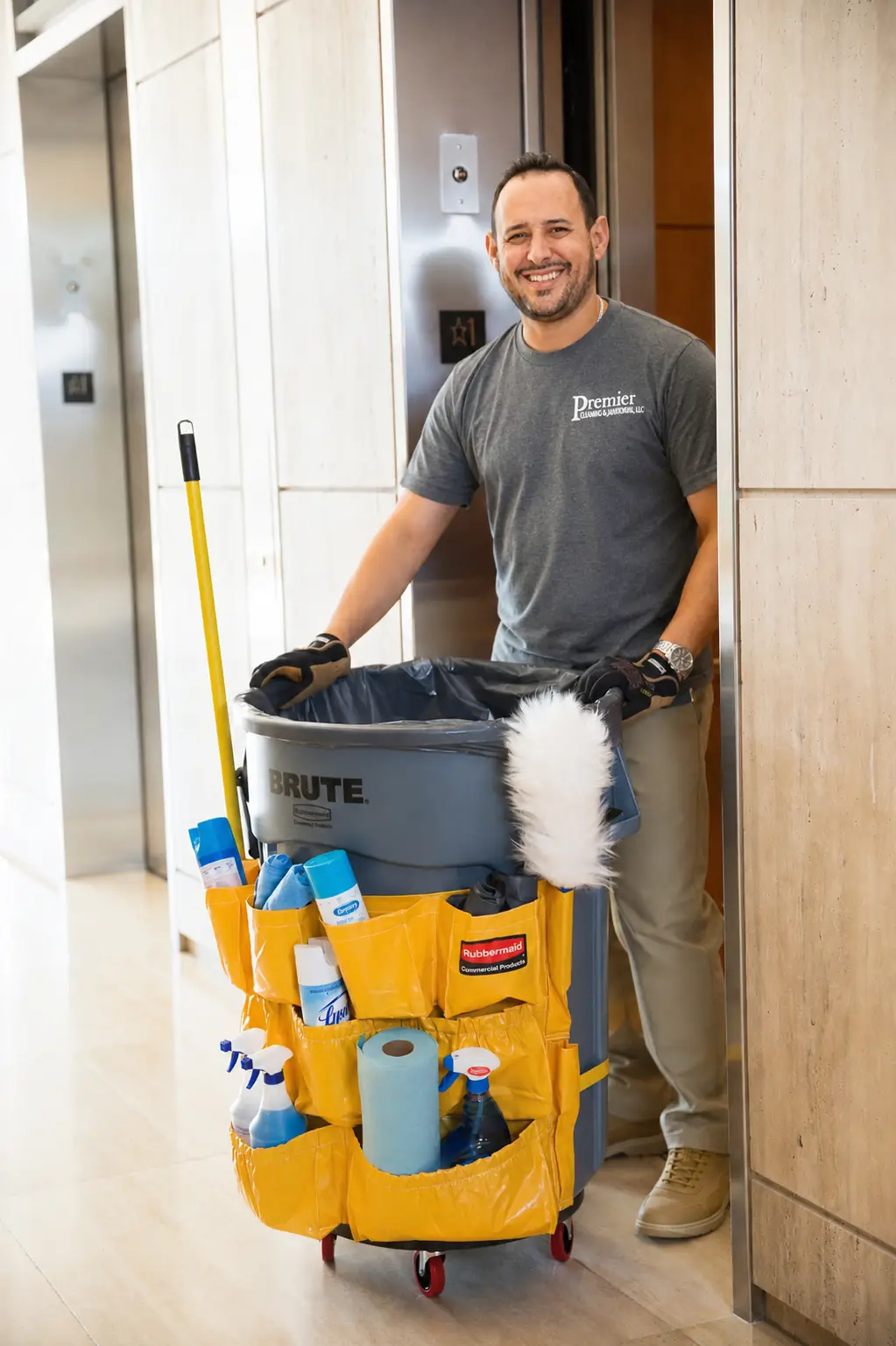
One night the restrooms shine and the desks get skipped. The next night the desks are perfect and the trash gets missed. Nobody’s lazy everyone’s just working without a system.
Premier Cleaning & Janitorial runs the same seven steps in the same order on every service night, in every building we clean. The order matters. Each step sets up the next one, and working out of sequence creates rework and cross-contamination.
Here is exactly what happens when our crew arrives at your building.
Step 1
Before a single cloth comes out of the cart, the lead crew member walks the facility. It takes three to five minutes and it’s the step most cleaning companies skip entirely.
If the walk turns up something that changes the plan — a large spill, an unexpected event setup, a broken fixture — the crew adjusts before starting rather than discovering the problem halfway through and backtracking.
Why it matters: most facility managers have had a contractor work blind and leave without noticing the leak in the corner. The pre-inspection is why our clients hear about issues in their building from us before they hear it anywhere else.
The pre-inspection catches
Step 2
Dust always comes before anything wet, and always top-down. This isn’t preference — it’s cleaning physics. Mop the floor before dusting the shelves and everything you dust lands on the wet floor. Now you mop twice.
We use microfiber dusters rather than feather dusters. Feather dusters redistribute dust into the air where it settles back within the hour; microfiber captures and holds it until the cloth is laundered.
Why the order matters: dusting is dry work, and dry work always precedes wet work. Get it done first and everything after stays clean the first time.
Dust sequence
Step 3
With the dust captured, we empty trash and recycling throughout the facility. This happens before wet cleaning because pulling bags kicks up debris and disturbs dust on bin lids and rims that would otherwise land on freshly wiped surfaces.
We also check bin condition. A cracked bin, broken lid or missing container gets logged and reported so you can replace it before it becomes an eyesore.
One thing we don’t do: shortcut liner replacement. Some companies re-use liners that “look clean.” We don’t. A used liner is a used liner.
Every service night
Step 4
This is where high-touch surfaces are cleaned and sanitized — the handles, switches and counters that every hand in the building touches.
We use EPA-registered chemicals, applied the way the label directs: spray, then wipe with clean microfiber. Each surface gets the product that suits it, and cloths are changed as they load up instead of being carried from desk to desk.
Why this comes before floors: wipe-down surfaces are horizontal. Anything that falls lands on a floor that’s about to be cleaned anyway.
Every service night
Step 5
The dirtiest zones come after the cleaner zones — never before. This is the single most important sequencing rule in commercial cleaning, and the one amateurs get wrong most often.
If a crew cleans the restroom first and then wipes desks, they carry restroom bacteria on gloves, cloths, cart handles and shoes into your workspace. It doesn’t matter how well they washed their hands — the equipment picks it up.
Clean-to-dirty sequencing is why our clients don’t end up with restroom organisms on their office phones.
Restrooms — every night
Break rooms — every night
Our microfiber cloths are color-coded to reduce cross-contamination. Cloths used in restrooms stay in restrooms and never touch desks, counters or break room surfaces, and they are laundered separately.
We apply this on every account type, not just medical. Your team doesn’t want restroom bacteria on their keyboard, and this is the reason they don’t get it.
Step 6
Floors come second to last because everything falls on them. Dust from Step 2, debris from Step 3, overspray from Step 4 and mop residue from Step 5 all end up on the floor. Clean floors before any of those steps and you clean them twice.
Floors almost always take the longest — usually 30–50% of total service time. They’re also the most visible: the floor is what your team sees first the next morning. We treat them accordingly, and we match chemistry to the surface rather than using one cleaner everywhere.
Dry work first
Wet work second
Periodic project work
Step 7
Before the crew locks up, the lead walks the facility one more time with the checklist. Same route as the pre-inspection, different purpose.
Any deficiency found is corrected on the spot — not tomorrow, not next time. The point is that nothing incomplete leaves the building with the crew.
The crew logs out with a timestamp and records any observations from the night. If something needs your attention before morning — a leak, a broken fixture, a security concern — you get a message immediately.
Weekly supervisor inspections: on top of the crew’s own final walk, a supervisor inspects every account weekly, using an inspection program and checklist custom-built for that facility. Your building is measured against its own standard, not a generic form.
Why it exists: everyone makes small mistakes. A missed bin, a skipped spot-mop, a paper roll that didn’t get restocked. The final walk catches them while there’s still time to fix them, instead of you finding them at 7 AM.
The final walk verifies
The seven steps above are the seven steps every commercial cleaning company performs.
The order is where most of them go wrong.
Every crew member clears a full nationwide criminal background check before their first shift. No exceptions, and nobody joins an existing account without the same screening.
We follow this order because it’s the only order that doesn’t create rework, cross-contamination or missed tasks. Every crew is trained on the sequence on day one. Every supervisor inspection grades against it. Every account gets the same order, every night.
Consistency isn't a personality trait. It's a system. This is our system.
Yes — this is our operational standard. Every crew is trained on the sequence during onboarding, every supervisor inspection grades against it, and any deviation is flagged and corrected. The order is the process.
It depends on facility size, frequency and scope. A 5,000 sq ft office on a standard nightly scope typically runs 1.5–2.5 hours from Step 1 to Step 7. A 20,000 sq ft mixed-use facility might run 4–6 hours.
The step still gets executed, just faster. A small office with one restroom and no break room still gets Steps 5 and 6 — they simply take less time. The sequence doesn't change with facility size.
No. Every step happens on every service. What changes with scope is the depth within each step. Skipping steps is what produces cross-contamination and missed tasks.
Step 4 is the general workspace — desks, door handles, light switches, conference rooms. Step 5 is specifically the two dirtiest zones, restrooms and food areas, with dedicated color-coded cloths and different chemistry. The separation is what prevents cross-contamination.
The lead crew member on that night's shift. On solo-crew accounts that's the same person doing the cleaning. On multi-person crews the lead performs both walks while the others prep equipment and stage supplies.
It gets corrected before the crew leaves. If it can't be — a supply that isn't on the truck, damage needing a follow-up visit — it's logged and scheduled for the next service, and you're notified.
Yes. What changes is the content within each step. Medical accounts get closer attention to exam rooms, waiting areas and high-touch surfaces in Step 4. The sequence never changes.
Janitorial is the recurring nightly work — trash, restrooms, vacuuming, dusting, mopping, high-touch sanitizing — on a fixed schedule. Commercial cleaning usually refers to periodic project work like carpet extraction, window washing or post-construction cleaning. We do both.